Judicial review claims rise significantly
The latest civil justice statistics reveal a notable increase in judicial review claims and county court cases
The Civil Justice Statistics Quarterly for April to June 2026 has highlighted a significant surge in judicial review claims in England and Wales. Law Society of England and Wales president Mark Evans has pointed out that “judicial review claims have surged by 42% over the past year to their highest level since 2015, showing how important it is for our communities to hold public bodies to account.” This rise in judicial review applications is primarily driven by increased civil cases, notably in areas such as education, housing, and homelessness, which Evans emphasises have a direct impact on people's daily lives and access to essential services.
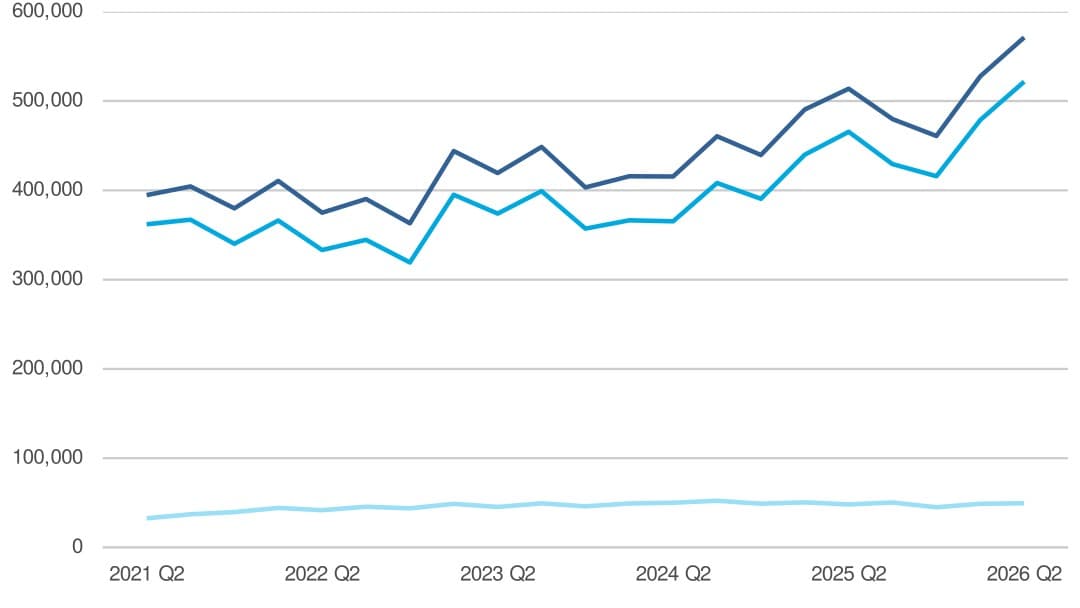
In addition to the surge in judicial review claims, county court claims also saw a rise. The figures show a sharp increase of 11% from the same period in 2025, totalling 571,000 claims, with 87% of these being money claims, an increase of 13%. Interestingly, while the number of claims defended increased by 15% to 82,000, the number of trials decreased by 10% to just 12,000.
Despite the overall increase in claims, there was a notable downtrend in damages claims, which fell by 4% to 26,000, attributed to decreases in personal damages and other damages claims. Evans has further pointed out that the courts require more government support to manage the rising demands efficiently, as “the government must also ensure that its justice reforms consider the impact on other parts of the system." He cautioned that restricted appeal routes may further complicate the situation, leading to heightened pressure on judicial review applications.
The statistics also reveal that median time taken from claim to hearing for small claims has risen to 41.0 weeks, a slight increase of 0.7 weeks from the previous year, while the time for fast/intermediate/multi-track claims has improved by 6.1 weeks to a total of 55.9 weeks. The overall judgments have also seen a significant rise of 26%, and 94% of these were default judgments.
In conclusion, the data reflects an ongoing trend that highlights the necessity for an effective civil justice system that addresses the needs and concerns of the public. Evans’ commitment to monitoring these trends indicates a responsive approach as demand for justice and accountability becomes increasingly urgent.
 Copyright & permissions