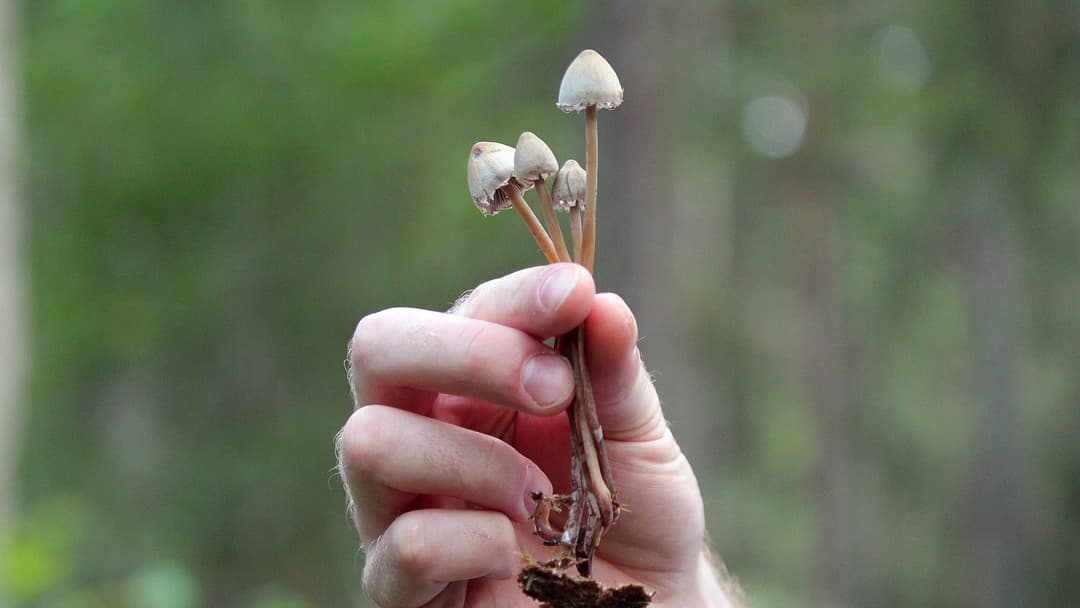
Magic mushrooms are experiencing a renaissance.
Psilocybin, the compound that creates the “magic” in the mushrooms, is quickly converted in the body to psilocin which then binds to serotonin receptors, our “happy channels,” triggering euphoria, altered perception, hallucinations and spiritual experiences. Studies have also shown that psilocybin therapy can alleviate treatment-resistant depression and addiction.
The difficulty for proponents of magic mushrooms is, of course, that they are illegal in the UK.
Under the Misuse of Drugs Act 1971 (MDA), substances considered “dangerous or otherwise harmful” when misused are classified according to their level of harm: Class A, B and C. Psilocybin and psilocin themselves have both been historically classed as Class A drugs alongside cocaine and heroin, but it was only in 2005 that the mushrooms themselves were classified as such.
Possession of magic mushrooms carries a maximum sentence of seven years’ imprisonment and an unlimited fine. Production or supply carries a maximum sentence of life imprisonment.
Importing magic mushrooms into the UK constitutes separate offences under the Psychoactive Substances Act 2016 and the Customs and Excise Management Act 1979 (CEMA), with penalties comparable to supply. There is no exemption for personal use, small quantities, or online purchases.
A key word in the CEMA legislation is ‘attempt’. In cases where drugs (or other prohibited items) are intercepted by UK border agencies, it is not a defence to say that the accused never received the parcel or received substituted contents. In practice, many police investigations arise from (small) online orders intercepted at the border.
A brief history
The use of magic mushrooms long predates modern drug laws. Indigenous cultures in Central America including the Aztecs used them in ceremony, referring to them as teonanacatl, meaning “flesh of the gods.”
Western interest was ignited in 1955 when R. Gordon Wasson, a banker from J.P. Morgan, participated in a traditional Mazatec mushroom ceremony in Huautla de Jiménez, Mexico. He sent samples of the mushrooms to Swiss chemist, Albert Hofmann, who isolated and synthesised the psychoactive compounds, psilocybin and psilocin.
However, scientific research and the use of psychedelics came to an abrupt end in the 1970s when the US criminalised them. The UN Convention on Psychotropic Substances and the UK MDA followed suit a year later in 1971.
It is a widely held view that magic mushroom compounds were classified not because of scientific evidence of harm but as part of a broader political response to LSD and the anti-war movement. The subsequent legal framework was rigid and precautionary, with no regard for recognised medicinal and therapeutic use.
The loophole years
For many years, the MDA contained a significant loophole with regards to magic mushrooms. Although the statutory definition of controlled substances included psilocybin and psilocin, it did not include raw mushrooms. As a result, fresh magic mushrooms could be lawfully sold and possessed, provided they were not dried or otherwise “prepared.”
Throughout the 1990s and early 2000s, this ambiguity was widely exploited. By 2005, an estimated 400 stores openly sold magic mushrooms, including well-known markets such as Camden and Portobello Road.
The contradiction was compounded by Customs and Excise (now HM Revenue & Customs) which subjected magic mushrooms to VAT on the basis that they were consumed as a “stimulant” rather than as nutrition. This effectively acknowledged their drug status whilst permitting their commercial sale in order for the government to collect tax.
In 2005, Parliament amended the MDA to close the loophole, classifying “fungus (of any kind) which contains psilocin or an ester of psilocin” as a Class A drug. Fresh mushrooms became illegal overnight, making possession, cultivation and supply serious criminal offences.
Although spores themselves remain legal to possess, once they germinate and produce psilocybin, criminal liability follows.
Cultural perception and evolution of research
Magic mushrooms occupy an unusual cultural footing. Unlike LSD, cocaine or heroin, magic mushrooms have never completed the cycle of excess, backlash and taboo.
Rather, for a generation, they were legal, seasonal, and discussed with relative casualness, associated with folk traditions and nature rather than criminality.
Interest in magic mushrooms has revived recently through a convergence of factors including renewed research on the use of psychedelics in mental health treatment, Silicon Valley enthusiasm for microdosing, and global conversations around decriminalisation.
In 2018, Professor Michael Pollan’s How To Change Your Mind brought the science and history of psychedelics back into the mainstream. It topped The New York Times Best Sellers list and, in 2022, was adapted into a Netflix documentary.
In various parts of the world, legal approaches remain fractured. Psilocybin is legal in Jamaica. Certain ceremonial uses are protected in Mexico. Psilocybin truffles are legal in the Netherlands. Some US cities, including Washington, D.C., have decriminalised personal use of magic mushrooms in an ironic reversal of their position as frontrunner of the 1970s war on drugs.
The UK’s growing disconnect
Against this background, the Government’s rigidity places the UK increasingly at odds with international trends.
Although the UK launched the world’s first centre for psychedelic research in 2019, and has been at the forefront of academic research, psilocybin is still listed in Schedule 1 of the Misuse of Drugs Regulations 2001. Drugs in Schedule 1 have no recognised medicinal use. Research into therapeutic potential operates under strict Home Office licences that can make clinical trials expensive, time-consuming and logistically difficult.
UK advocacy groups are pushing for revolution. They have called for certain Schedule 1 psychedelic drugs to be moved into Schedule 2 to remove barriers to clinical trials, whilst retaining their Class A status under the MDA.
Historically, the UK Government has been opposed to such change. However, in July 2025, in response to a 2023 Home Affairs Committee report which advocated “urgent” rescheduling, the Advisory Council on the Misuse of Drugs agreed with the recommendation in principle but subject to operational feasibility; it is yet to be implemented. Since then, it appears no rescheduling is underway and no report has been commissioned. Psilocybin remains a Class A/Schedule 1 drug.
Sentencing remains governed by the standard Class A drug guidelines with no -psychedelic-specific adjustment.
Meanwhile podcasts, social media, culture and wellness platforms frequently promote magic mushrooms using language that implies legality, discretion and therapeutic benefit.
Practical problems
This visibility and discourse creates a false sense of legitimacy, reinforced by the historical memory of mushrooms once being lawful, with real-life consequences.
The presentation of magic mushrooms as lifestyle products bears little resemblance to their treatment by the UK criminal justice system.
Interception at the border frequently leads to criminal investigation, arrest and prosecution. Many defendants are genuinely shocked that ordering a small quantity of magic mushrooms online, even for personal use, constitutes a serious Class A drug offence.
This has resulted in an increase in individuals investigated for magic mushroom offences. According to the latest ONS statistics on the misuse of drugs, 1.1% of adults aged 16-59 in England & Wales used magic mushrooms in the year ending March 2025, up from 0.5 % in the year to March 2020.
Conclusion
The gap between cultural perception and legal consequence is unusually wide, and it is widening as the psychedelic renaissance gathers momentum.
Until Parliament revisits the classification of magic mushrooms with scientific specificity or until public enthusiasm wanes, magic mushrooms will occupy a uniquely dangerous position: marketed online and across the world as ancient and therapeutic, yet prosecuted according to statute as one of the most serious drugs when misused.


.jpg&w=256&q=75)

 Copyright & permissions