Lyons v Bridging Finance: High Court upholds bankruptcy order against Bahamas-domiciled property investor
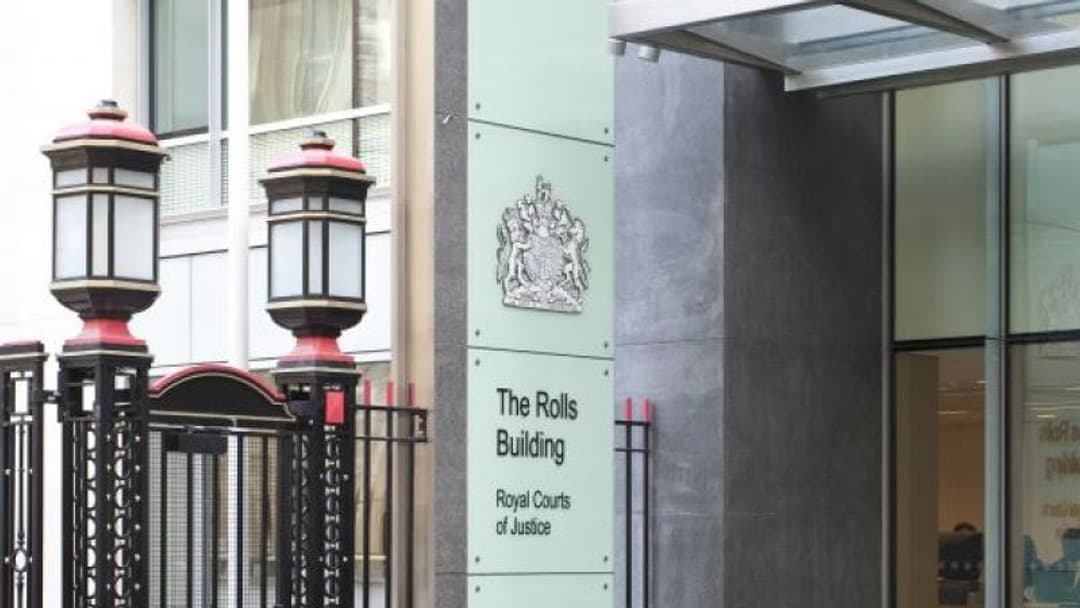
Chancery Division confirms single-property development in England sufficient to establish "carrying on business" jurisdiction under Insolvency Act 1986
The High Court has dismissed an appeal against a bankruptcy order made against a property investor domiciled in the Bahamas, confirming that a solitary but substantial property development carried out through agents in England can constitute "carrying on business" for the purposes of section 265 of the Insolvency Act 1986. The judgement in Anthony Lyons v Bridging Finance Inc [2026] EWHC 1388 (Ch), handed down by Mr Justice Rajah on 9 June 2026, also addresses the exercise of discretion over foreign debtors and the limits of the Re Brauch general business basis.
The petition debt of CAD $39 million (approximately £26.6 million) arose from a personal guarantee given by Mr Lyons in October 2018 in support of a loan by Bridging Finance Inc to an English company he beneficially owned, which had used the funds to acquire a senior lending position in a troubled Northumbrian property development. When Mr Lyons challenged jurisdiction, having emigrated from England in 2010, the question was whether he had "carried on business" in England and Wales at any point in the three years preceding the presentation of the petition in July 2024.
Deputy ICC Judge Baister found against Mr Lyons on what was termed the "Hamilton Terrace business basis". That property, registered in Mr Lyons' own name, had been acquired in 2003 as a joint venture with a Mr Todd, who subsequently withdrew. Over nearly two decades Mr Lyons, through his agent Mr Conway and the Matterhorn Capital management team, had redeveloped it from five flats into a single substantial residence, let it at rents of around £25,000 per week, and ultimately sold it in March 2022 for over £26 million. The sale fell within the relevant three-year period. A bankruptcy order was made.
Mr Justice Rajah upheld the first instance decision on Ground 1. Rejecting the argument that the absence of a subjective profit intention was fatal, the court held that while a profit motive is ordinarily a component of "carrying on business" in its natural meaning, it is simply one circumstance among many rather than a conclusive requirement. The inference that Mr Lyons had developed Hamilton Terrace with a view to profit was described as obvious. The fact that he had reluctantly assumed full responsibility for the project after his joint venturer's exit, and had rented the property to enhance its marketability pending sale, did not dissolve the commercial character of what remained a property development venture throughout. Applying the Scottish Court of Session's reasoning in IRC v Livingstone (1927) by analogy, the court confirmed that an isolated but complex commercial venture of the same kind as ordinary trading in a recognised line of business is capable of constituting the carrying on of that business.
On Ground 2, which had not been argued before the Deputy ICC Judge, Mr Justice Rajah accepted that the court retains a discretion not to make a bankruptcy order against a foreign debtor even once jurisdiction is established, applying JSC Bank of Moscow v Kekhman [2015] EWHC 396 (Ch) and the Latreefers test. He exercised the discretion afresh and concluded that all three factors were satisfied: Mr Lyons had a sufficiently close connection to England through the Hamilton Terrace business; there was a reasonable possibility of benefit given his numerous UK and Luxembourg-held assets and potential claw-back claims; and the petitioner, having submitted to English jurisdiction by issuing the petition, was a person interested in the distribution of assets over whom the court could exercise jurisdiction.
The respondent's notice, seeking to uphold the bankruptcy order on the "general business basis" under Re Brauch, was addressed but found to be academic. The court declined to interfere with the Deputy ICC Judge's evaluative finding that it was insufficiently possible to isolate acts done by Mr Lyons in a purely personal capacity, as distinct from his role as controller of his corporate network, during the relevant period. On the timing issue, it was open to the judge to conclude that no relevant company promotion or acquisition had occurred within the three-year window.
Anthony Lyons v Bridging Finance Inc [2026] EWHC 1388 (Ch). Christopher Boardman KC (Kingsley Napley LLP) for the appellant; William Willson KC (Dentons) for the respondent.
 Copyright & permissions
.png&w=3840&q=60)








.jpg&w=3840&q=60)