Global M&A legal rankings show elite firm movements
The latest M&A rankings reveal significant shifts as elite firms consolidate power in a recovering market
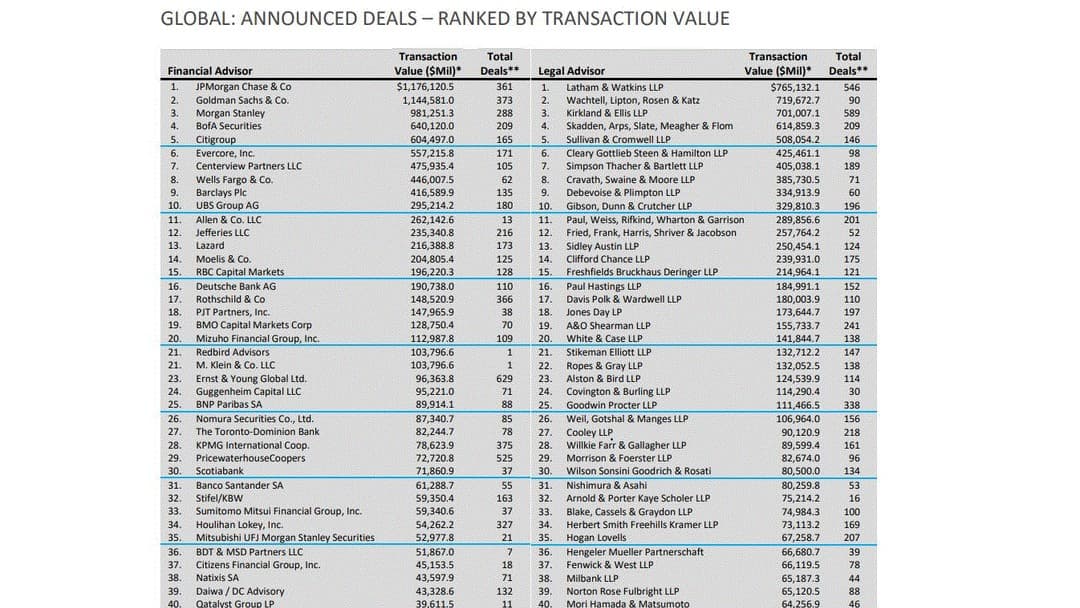
The Q1 2026 preliminary global M&A legal rankings uncover substantial changes in deal value concentration and competitive positioning among leading law firms. According to data compiled by LSEG a provider of financial markets infrastructure and financial data, the total industry deal value surged to approximately $1.03 trillion, a striking increase from $761.6 billion in Q1 2025, reflecting a robust resurgence in global M&A activity. However, this surge occurred alongside a drop in the overall number of deals, which declined from 12,070 to 9,772. This trend indicates a marketplace increasingly characterised by larger and higher-value transactions while fewer deals are taking place.
At the forefront, Sullivan & Cromwell steadfastly holds its leading position, boosting its total deal value to $177.7 billion and elevating its market share to 17.28%. Although the firm managed fewer deals than the previous year, its grip on high-value transactions highlights a prevailing trend wherein elite firms are attracting a greater share of megadeals.
In a noteworthy development, Wachtell Lipton Rosen & Katz skyrocketed from 21st place in 2025 to 2nd in 2026, with its deal value nearly quadrupling. This striking advancement signifies a remarkable return to the upper echelons of M&A advisory, driven by strategic deal selection and a commitment to high-impact transactions over sheer volume.
Kirkland & Ellis, a long-standing titan in deal count, retains its position at 3rd place with a commendable 149 deals, the highest among top firms. Nevertheless, the firm faces a slight drop in market share. Latham & Watkins likewise maintains a hefty activity level with 129 deals, yet suffers decreases in both ranking and market share, suggesting that mere volume may no longer dictate market leadership.
Firms such as Gibson Dunn & Crutcher and Skadden have also displayed considerable upward movement, enjoying increases in both ranking value and market share. In contrast, Freshfields and Cleary Gottlieb have encountered declines, hinting at heightened competition and shifting client interests in complex and cross-border transactions.
Another emergent trend is the ascent of mid-tier firms, which are carving out competitive niches. For instance, Goodwin Procter LLP handled 148 deals, second only to Kirkland, while achieving notable enhancements in ranking value. Firms like Herbert Smith Freehills, Kramer, and Allens also recorded significant gains, showcasing a broader diversification in competitive strength across different regions.
Conversely, some firms have experienced severe declines. King & Wood Mallesons and Schoenherr Attorney’s at Law saw sharp drops in both ranking and deal value, possibly indicative of reduced activity or a loss of major mandates. Furthermore, Baker McKenzie and Sidley Austin slipped in rankings, despite maintaining moderate deal volumes.
Overall, the 2026 data outlines a more polarised market structure, where high-value transactions are becoming concentrated among a select group of elite firms, while mid-tier competitors focus on volume and regional expertise. The observed decline in total deal count, juxtaposed with rising aggregate deal value, reinforces the notion that clients are increasingly prioritising fewer, larger, and more strategically significant transactions.
To sum up, Q1 2026 represents a crucial turning point in the landscape of global M&A law. The data signals not just a revival in deal-making but also a fundamental shift towards value concentration, strategic advisory capabilities, and intensified competition among elite firms.
 Copyright & permissions
.jpg&w=3840&q=60)

-cropped-6au25meu.jpg&w=3840&q=60)





.JPEG&w=3840&q=60)